Strategies for Learning From Failure in Harvard Business Review by Amy Edmondson
In this article, Jonas Dahl and Andreas Werr depict how organizations can learn from their mistakes. But although many failures are opportunities to learn, actually encouraging people to share their failures is easier said than done. The authors give suggestions on how to exercise become nearly information technology.
Download the PDF
Jonas Dahl and Andreas Werr
The COVID - 19 crisis has challenged established work-practices and initiated a vibrant innovation behaviour. What a couple of months agone seemed impossible is now freely experimented with – and experiences, positive equally well as negative , are made at a loftier rate providing ample opportunities for learning both for individuals and organizations. Research as well as experience, yet , tell us that failures, in spite of being an of import source of learning , are non often shared and explored every bit learning opportunities. What do nosotros know about individuals' willingness to share errors and how tin this exist shaped by organizations?
Failures – a northward underutilized learning opportunity
While most organizations espouse the idea that failures are unavoidable and should be exploited as a learning opportunity, organizational and managerial action often sends the opposite message. In a written report of managers' attitudes and reactions to failures, Amy Edmondson (one) found that that even if managers only saw 2-5% of the failures committed in their organizations as "bad" failures that deserved to be punished, 70-90% of failures were actually treated equally "bad" and punished in unlike ways.
Failures, divers as " individuals' decisions and behaviours that 1) result in an undesirable gap between an expected and a real land and two) may lead to actual or potential negative consequences for the organizational functioning that could take been avoided" (2) , are a natural attribute of work , especially in the context of innovation and dealing with the unf amiliar issues brought on by a crunch. And failures may have very different qualities. Equally pointed out past Amy Edmondson (1) , failures may range from blameworthy (e.k. deliberate failures) to praiseworthy (failures that induce profound learning). It is the latter we are concerned with here.
Equally new issues are tackled and new ideas tested , occasional failure is unavoidable. In these situations, u nderstanding why the decisions and behaviours did not lead to the expected outcomes thus become s an important trigger for revising our current understanding of a trouble or situation that may help u.s.a. deal with it more constructively in the future. While this analysis can be done on the individual level, the existent potential lies in the collective analysis as this may provide more profound insights as well equally make this learning bachelor to more individuals. Unfortunately, however, we know that individuals in organizations are far more decumbent to share their successes th a n their failures with each other – and when they share failures this seldom leads to the kind of profound assay that identifies root causes and prevents the failure from existence repeated (iii) .
The COVID-19 crisis has met organizations with a big set of new challenges calling for untested solutions. For instance, a majority of the workforce w equally of a sudden forced to work from home on a regular footing and meetings were moved from a concrete to a virtual space . This scenario is set for the possibility of failures , in plough leading to learning opportunities. But, will they be shared and discussed as learning opportunities? Or hidden and soon forgotten to be repeated by others?
The Pharmaceutical company Roche is one of the many organizations exploring the new challenges caused by COVID - nineteen – and learning from their experiences of distance work as they go. In reflecting on the experiences , the Head of People & Culture at Roche Sweden acknowledges a greater openness to failures in a crisis context:
We take seen that we have a more open up, a more forgiving surround , for example accepting failures from the facilitators, who run the meetings [which have moved from concrete to virtual space] . We have been more businesslike and tolerant if some things have not been perfect and we have given more clear feedback, eastward.g. "Can you delight mute since in that location is a noise in the background" or "Is your married woman aware that she is visible in the groundwork?" One practical example of acceptance of failure I experienced simply recently was when we divided a group of leaders into pairs during a workshop for a coaching session. During the selection one colleague was left by herself . Without arraign, she reached out and said, "I am solitary hither in my group." This gave me the gamble to fix the mistake and leap into her group and start to coach her.
The crisis context has besides generated new formal and informal arenas for sharing exp eriences of failure and learning from them :
A central insight has been that we have had more improvised ways to capture the learnings so far – especially learning from experiences that did non turn out the way we wanted or expected. Examples include sharing of "worst" and "all-time" practices, both in digital meetings and from our digital communities. We have also seen more of self-organized sharing of both failure and success experiences where unlike learning groups take emerged.
This constructive exploitation of experiences of failure at Roche is viewed as strongly enabled by the organization ' s dedication to build a civilization more appreciative of failures as a learning opportunity. The investments are currently seen to bear fru it :
Fortunately, ahead of COVID - 19 we established several formal practices which have supported usa and made it more acceptable to experiment and systematically learn from our experiences, especially from failures. One example is our "Failure Days" which nosotros have had for 3 consecutive years. Another practice which is a part of how nosotros exercise things at Roche are " A fter B urners", where we openly share experiences, analyze and evaluate our key projects. All these practices accept contributed to that nosotros more often enquire ourselves : "Ok, it did non become co-ordinate to program but what did we learn?" ( Head of People and Culture , Roche Sweden)
Encouraging failure sharing in organizations
While few organizations volition object to the full general idea that failures should exist shared and larn t from, making this happen is more than challenging, and, as our own and previous enquiry indicates, it is easy to fail fifty-fifty with the best intentions. In the post-obit nosotros summarize some of the actions organizations may take to increase the sharing of failures.
Decrease the costs and increment the benefits of failure sharing . Failure sharing has in previous research been viewed every bit a discretionary and potentially risky behaviour which is the upshot of a deliberate decision procedure that is affected past both individual and contextual factors (two). In line with this, previous research has argued that individuals decide whether to share failures or not based on a situation cess, in which the costs and benefits of sharing are identified and weighted against each other (see table 1).
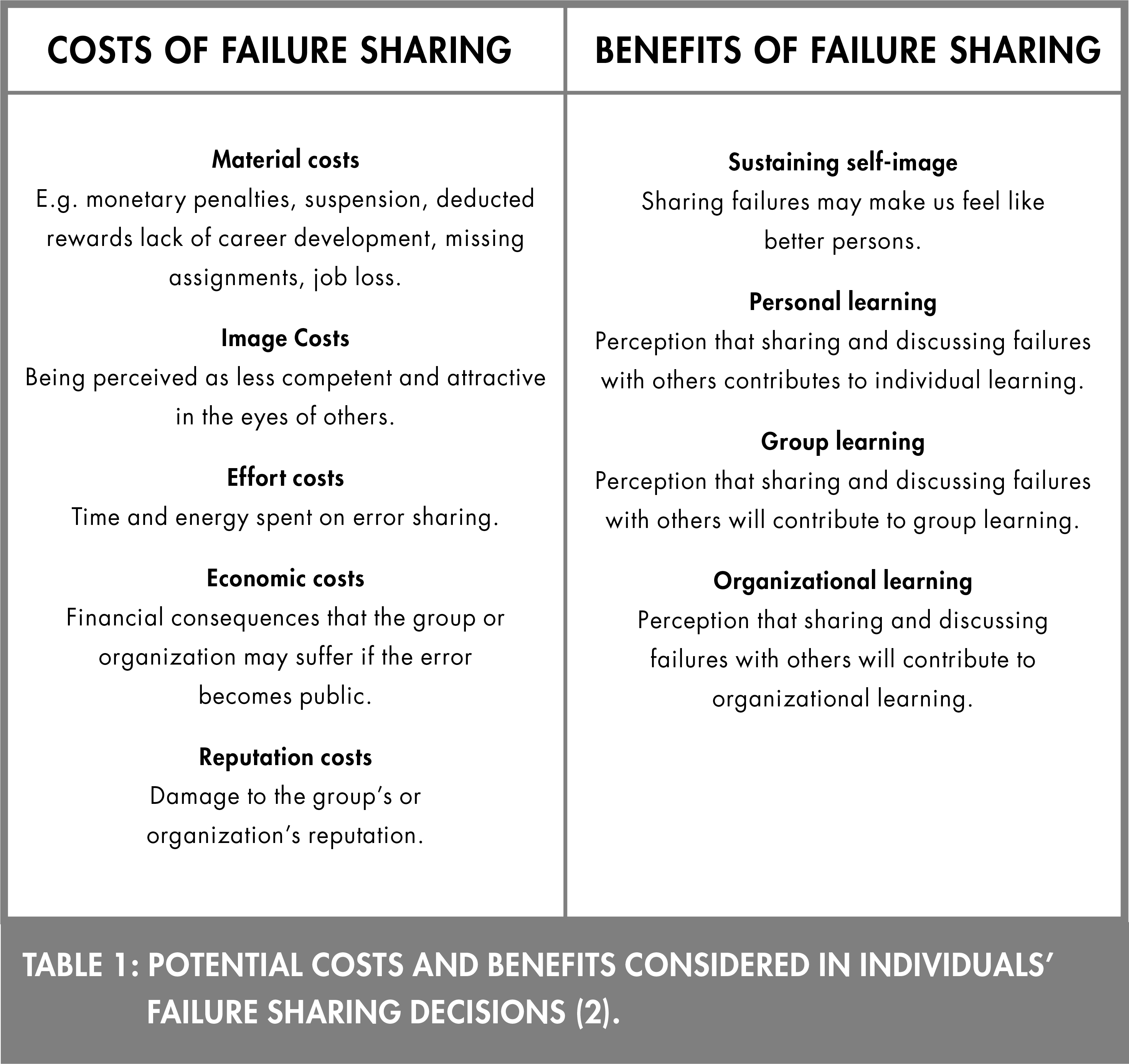
Organizations that desire to increase failure sharing demand to reduce the perceived costs and increase the perceived ben efits. The costs of failure sharing could be reduced, for example, by abolishing explicit punishments for failures, reducing the stigma of failures to lessen image costs, creating formal occasions for failure sharing to reduce effort costs, or putting into identify systems to discover and deal with errors to reduce economical and reputation costs. They may also increment the perceived benefits by openly acknowledging and communicating le ssons learn t from failures .
Equally illustrated by the example of Roche, times of crisis may temporarily change the salience of unlike toll s and benefit southward every bit some of the potential costs of failures may be temporarily lowered and the benefits increase . As the organization is faced with new bug without obvious solutions, tolerance for failure may increase, thus lowering paradigm and reputation costs and as many are struggling with similar issues the benefits of sharing experiences of failure increment.
Emphasize learning over operation to avoid the shame of declining . Current organizations in their formal and informal assessment of individuals typically focus on operation rather than learning. However, continuous performance comes from learning. The seminal piece of work past psychologist Carol Dweck (iv) has shown that individuals who are mainly focused on achieving high operation are less likely to seek challenges and seize learning opportunities and respond constructively to failures than individuals seeking out opportunities for learning. These latter individuals are more prone to seek challenges – and deal with and learn from potential failures.
T he organizational context may button individuals either towards a functioning goal orientation or towards a learning goal orientation. While "excellence" is an oft-celebrated virtue in organizations, this may risk inducing a performance goal orientation and make failing a shameful experience. In a professional person service s firm nosotros studied, the individual consultant was depicted equally possessing unlimited abilities and was mostly portrayed as successful reflecting a functioning goal orientation. This well -intentioned boosting of the employees, however , had the unintended consequence of stigmatizing failures equally a potential personal flaw. As employees were depicted every bit flawless, those experiencing failures to a big extent questioned their professional person sel ves , thus inducing shame, a feeling that led them to hide and withdraw, or blame others, rather than share and learn from their failures with colleagues.
Instead , organizations may strive towards inducing a learning goal orientation, which is more conducive to failure sharing. This may exist washed by an open up acknowledgement of failures and their potential for learning and past depicting the employee not every bit a "perfect" individual only as a developing individual. To enforce this, organizations may institutionalize processes of feedback and reflection. In such a context, failures go a natural aspect of work with a positive potential for learning. Try and creativity in approaching an issue should be rewarded as highly – if not fifty-fifty more than so – than the accomplishment of performance itself .
In this vein, another professional service due south firm we researched depicted the platonic consultant as "proud merely not satisfied" and encouraged the provision of developmental feedback to colleagues after each client assignment. The positive image of the highly competent consultant was combined with an emphasis on seeking out learning opportunities. "Nada is always so expert that it cannot get better" was a message repeatedly communicated by the CEO. This induced a learning goal orientation ( four ) amidst consultants – a concern with increasing competence – which made failures a more natural and potentially valuable aspect of piece of work that could be more openly talked about.
Create opportunities for failure sharing . Endeavor and emotional costs of failure sharing can be reduced past legitimate contexts in which failures can be shared. In this vein, managers may systematically comprise failure sharing in their supervisory routines . They may, for example, discuss failures in weekly coming together south. I of the organizations studied past u.s. had the detail "the week 's hit and shit" on the calendar of the weekly department meeting. Other organizations hosted failure sharing lunches, threw f ailure function ies or handed out " failure -of-the-month award s " . And Roche, every bit discussed in a higher place, had recurring projection debrief south ( and then called A fter B urner s ) , and an almanac F ailure D ay that gather ed large parts o f the organization in a sharing and learning from failures . A central activity o n that day was the opening session where members of the summit management squad pace p ed up on stage to share their ain professional failures. They disembalm d both their painful emotions and learnings and thereby helped employees to mind shift to a failure sharing culture that emphasizes the unavoidable nature and benefits of failure . The Failure 24-hour interval was as well a "dare-to-share" event in which participants gained appreciation for their failure sharing. A t the about recent F ailure D ay at Roche a spontaneously shared story past a first-line manager a tour fail ing in her leadership office , and consequently learning from information technology received a long applause and a positive boost from the participants .
Create a safe space . Sharing failures is a risky action for the individual. This risk may be mitigated past the social climate in which the failures are to be shared. Amy Edmondson (5) has identified "psychological safety" – "beliefs almost how others will answer when 1 puts oneself on the line, such as by taking a take chances , request a question, seeking feedback, reporting a mistake, or proposing a new idea" (v) – as an important condition for failure sharing and learning in organizations. In gild to share failures, individuals need to feel that they will be supported by their peers and that the failures volition not be used against them, just rather appreciated equally a learning opportunity. While a climate of psychological safety is a collective responsibility, managers have an important part to initiate and safeguard it. Mangers may do that by show ing vulnerability past , for example , request for aid , inviting feedback, shar ing own failure s and weaknesses , and encourag ing others to follow , but besides by guarding the norms of support and mutual respect past other squad members (encounter also the chapter past Runsten & Werr ).
Concluding thoughts
The COVID-19 crisis has confronted many individuals and organizations with unprecedented disruptions in their current means of working (see besides article past Pemer ) which has led to vibrant innovation activity where new means of working are developed and tested – with successes and failures following. T his provides a unique opportunity to greatly redesign work as we motility through the crisis – and many are convinced that the world of piece of work after the crisis will be fundamentally different. The quality of the emerging means of working volition, withal, depend on our ability to acquire from the experiences, and particularly the failures, made , and then we had amend first building the contexts in which these can be freely shared and learned from.
References
-
Edmondson (2011) . Strategies for learning from failure. Harvard business review, 89(iv), 48-55.
-
Zhao, B., & Olivera, F. ( 2006 ) . Error reporting in organizations. University of Management Review , 31(4): 1012-1030.
-
Dahlin, Grand. B., Chuang, Y. T., & Roulet, T. J. (2018). Opportunity, motivation, and ability to acquire from failures and errors: Review, synthesis, and ways to move forward. Academy of Management Register , 12(one), 252-277.
-
Dweck, C. S. 1986. Motivational processes affecting learning. American psychologist , 41(10): 1040.
-
Nembhard & Edmondson ( 2012 ). Psychological safety. In The Oxford handbook of positive organizational scholarship. Oxford: Oxford University Press
The Authors
Jonas Dahl is a PhD candidate at the Department of Direction and System at Stockholm School of Economic science. He is partner and senior consultant at Gaia Leadership.
Andreas Werr is Professor holding the Lars Erik Lundberg Chair in Business Administration at the Section of Management and Arrangement at Stockholm Schoolhouse of Economics.
Source: https://www.hhs.se/en/research/sweden-through-the-crisis/learning-from-failures/
0 Response to "Strategies for Learning From Failure in Harvard Business Review by Amy Edmondson"
Post a Comment