New York Times Review Killing the Rising Sun Bill Oreilly
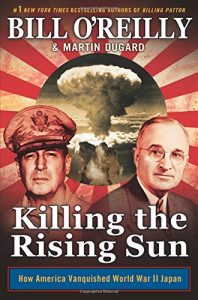
Past Neb O'Reilly and Martin Dugard
323 pages
Henry Holt & Co.: New York, 2016
Jason Morgan, for JAPAN Forrard
In April 2017, disgraced former Fox News personality and self-styled "conservative" pundit Bill O'Reilly denounced equally a war crime the use of chemical weapons in an attack on Syria. Merely a yr earlier, however, O'Reilly and co-author Martin Dugard published Killing the Rising Sun: How America Vanquished World War II Japan , a virtual encomium to the employ of atomic weaponry against Japanese civilians in August of 1945.
How can the same person denounce the wholesale slaughter of innocent people in one part of the earth, but applaud information technology 72 years earlier in another? What ideological razor is abrupt plenty to separate these ii seemingly identical acts?
The answer is neo-conservatism, or the belief that the exercise of American power is right just because it is American. This ideological approach hobbles Killing the Ascent Dominicus from the very offset page, and ends up most eliminating its potential for analysis in exchange for the certainty of wars won long ago past the overwhelming display of American military might.
There are countless ways in which Killing the Ascent Sun might have removed the ideological filter and let in the deep shades of historical nuance. Doing and then, ironically, would have actually served to inure the authors against propaganda of other varieties.
On the issue of the comfort women, for example, the "ii hundred thousand" comfort women said to have been "forced into sexual slavery"—a favorite "talking betoken" of Beijing—is unsupported by documentary testify. (O'Reilly and Dugard thus find themselves in complete agreement with communist China—a very curious position for someone similar O'Reilly who prides himself on seeing through governmental spin.)
American and Japanese academics have long sought to produce some form of written proof that kidnappings and sexual enslavement occurred on the scale claimed by Communist Political party members in both Red china and Japan. The search has yielded nothing.
When the United states of america regime formed the Interagency Working Group (IWG) in order to chase down records in the American archives validating the outlandish claims, it, besides, came up empty, even after spending seven years and $30 one thousand thousand in the attempt.
Wartime Military Records on Comfort Women , a new volume by US Regular army Colonel Archie Miyamoto, provides extensive documentary proof that the mass kidnappings imagined by a Japanese novelist and many American academics merely never existed.
While there were, in fact, isolated incidents of rape, kidnapping, and other forms of fierce abuse confronting the comfort women, these were crimes punishable by imprisonment and execution.
A case in indicate is the Semarang Incident in Republic of indonesia. During a breakup of military machine subject area under ane Major Okada around the Semarang area of central Java kickoff in early on 1944, some members of the Japanese military began impressing Dutch and mixed-race women held in POW camps into service every bit sex workers for Japanese soldiers and officers. When these crimes were discovered, the brothels were immediately close downward by other Japanese military authorities.
Later the war, when there had been time to sort through evidence and obtain testimony from witnesses, the Japanese military men who had organized and carried out the forced-prostitution operation were tried as Class B and C war criminals. Okada, the ranking officer, was executed by the courtroom martial in 1948; the other criminals were imprisoned for between 2 and twenty years for their crimes.
The comfort women arrangement did be. The Semarang Incident is highly atypical in that almost all of the comfort women were not recruited past brokers only rounded up past war machine men. Indeed, with a hellish war to fight on all fronts, the Japanese war machine had petty time or men to spare to tend to the recruitment and maintenance of brothel workers. Comfort women were prostitutes servicing (sometimes exclusively, sometimes not) soldiers and officers in the Japanese armed forces. Only the piece of work of procuring the women and seeing to their personal needs was carried out by non-armed services operators.
A substantial number of condolement women were Japanese. Some were sold by their destitute parents into a life of sexual servitude in substitution for an "advance payment" which the young woman would work off over the class of a set number of years. Others were already professional prostitutes on the habitation islands who were attracted by the prospect of a much college income in the Japanese imperial territories.
At that place were indeed many comfort women from the Korean peninsula. The documentary evidence shows overwhelmingly that Korean women were recruited most often past Korean brokers and proprietors who pitched dandy potential income—oftentimes as much as Japanese generals—with the choice to leave and return domicile at the terminate of their contract.
Although the Korean peninsula was a part of Japan proper, having been annexed in 1910, not every Korean was able to speak Japanese, in particular those who were impoverished and had lilliputian access to instruction or any other means of survival. It would have been natural for Korean brokers to be the main nexus betwixt the Japanese armed services'south demand for brothel workers and the women themselves. They often had to rely on smooth-talking and charade to recruit women to practise what was undeniably dingy and bellicose piece of work.
On a related point, it should be stated clearly hither that information technology would have been impossible for the Japanese military to circular up hundreds of thousands of Korean women considering the Korean peninsula, of course, was not a battle zone during Earth State of war II. The number of Japanese troops stationed in Korea was very low—every available man was needed to fight the multi-forepart war confronting the Allies in the Pacific, Southeast Asia, China, and elsewhere.
As the sparse bibliography at the dorsum of Killing the Ascension Lord's day indicates the documentary evidence used to produce the volume is so tenuous as to qualify it as a piece of work of historical fiction, and not of history. I could not find a single monograph or article on the comfort women cited past O'Reilly and Dugard, and then it is incommunicable even to say which sources they have used to obtain the erroneous information given in the book.
A different trouble confronts O'Reilly and Dugard on the subject which forms the pillar of their argument, namely, that the dropping of the diminutive bombs on Hiroshima and Nagasaki in August of 1945 was a necessary evil which saved the lives of at least half a million United states servicemen. Whereas the comfort women issue is a subject with quite singled-out historical contours, the notion that 500,000 Americans would have died without the atom bombs is pure speculation, and can simply e'er remain and so. This unsolvable counterfactual has haunted Globe War II scholarship for more seventy years.
It is O'Reilly and Dugard's brunt to show that the employ of the atomic bombs was justified past the lives purportedly saved. But in order for this argument to hold together, its proponent must, by necessity, prefer a kind of Hegelian inevitability in which human agency comes to have a greatly attenuated bearing on the form of events.
The fact is that the Japanese were suing for peace earlier the decision to drop the bombs on Hiroshima and Nagasaki was made. The war could have been over before the Americans got to Okinawa, or even to Iwo Jima. The American determination to push button for unconditional surrender guaranteed that no peace overtures would exist entertained until the evangelical New Deal liberals, who oversaw the state of war, were convinced by Japan's "utter destruction," that Japan would never again pose a threat to "liberty and democracy" as the liberals defined it.
In no uncertain terms, the American liberals in 1945 saw themselves as the saviors of the world, and they were determined to effect salvation even—specially—if it meant reducing the enemies of freedom and democracy to ash and rubble. The only affair that made the invasion of Japan inevitable was the absolute inflexibility of the New Bargain liberals' confidence of their ain superiority.
In other words, it was not the Geschichtegeist that sent Fat Human and Lilliputian Male child to the skies over Japan. There were human being decisions at every link along the mode. Anybody involved could have stopped the process. There are no chain reactions of interpersonal human being will. Otherwise, history itself has no meaning.
Unfortunately, this history in the key of inevitability is precisely the kind of history in which O'Reilly and Dugard trade. This is anti-history history, convenient and soothing fiction, the kind of aggressive assent to unimpeachable American righteousness which has been used past the New Bargain liberals and their direct descendants, the neo-conservatives, to justify the grossest abuses of power.
O'Reilly and Dugard accept produced a racially-charged estimation of the Japanese equally brutal warmongers and wily deceivers, but the unsettling truth is that the accusers, in this case, have at least as much to answer for as the accused.
Since the book was published, Mr. O'Reilly has been forced out of Play tricks News over allegations of sexual venial. This has cypher to do with Killing the Rise Sun , of form, only where one might take hoped that O'Reilly'south early retirement would accept been the end of this kind of pseudo-historical emoto-cinematism, one is forced to admit that the genre is deeply ingrained in the American imagination, and likely long to continue.
Jason Morgan is an banana professor at Reitaku Academy
Source: https://japan-forward.com/book-review-oreilly-and-dugards-killing-the-rising-sun-is-anti-history-convenient-ficion/
0 Response to "New York Times Review Killing the Rising Sun Bill Oreilly"
Post a Comment